Ask any resident what the city is called, and the answer comes quickly: Pompey. The nickname belongs to Portsmouth, its naval base, and its football club with equal affection. Yet the origins of this enduring moniker remain contested, with three competing theories each claiming to explain how a place name transformed into a badge of local identity.
The Logbook Theory: An Abbreviation Takes Root
The most widely circulated explanation centres on Portsmouth Point, the historic waterfront district at the entrance to Portsmouth Harbour, better known as "Spice Island." According to this account, naval logkeepers abbreviated "Portsmouth Point" to "Po'm. P." in ship records to save time and space. Over years of repetition, the written contraction evolved phonetically into "Pompey," eventually attaching itself to the entire city.
This theory appears in published local histories, including Patterson's A Military Heritage (1985) and Webb, Quail, Haskell, and Riley's The Spirit of Portsmouth (1997). However, no surviving ship's logbook with the "Po'm. P." abbreviation has been produced as direct evidence, leaving the theory as locally accepted tradition rather than documented historical fact.
The French Ship Theory: HMS Pompee and the Prison Hulk
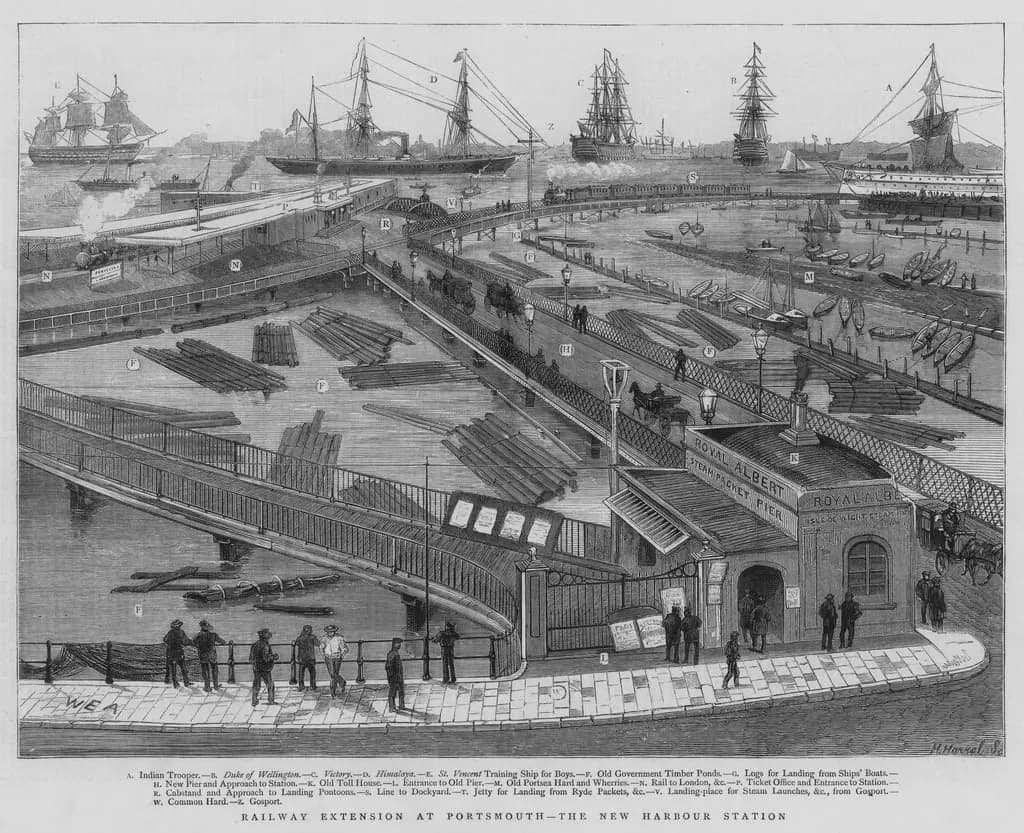
A second explanation traces the nickname to HMS Pompee, originally the French 74-gun ship of the line Pompée captured by the Royal Navy in 1793. The vessel served as a guard ship and prison hulk within Portsmouth Harbour from 1816 until being broken up in 1817. During this brief period, the ship became so closely associated with the port that its French name, anglicised from Pompée to Pompey, transferred to the harbour itself.
The prison connection runs deeper. Northern England slang for prison is "Pompey," possibly derived from criminals who served time aboard the hulk. The ship's dual role as both guard vessel and floating gaol may have cemented the name in naval and criminal vernacular alike.
The Egyptian Expedition: Pompey's Pillar
A third theory points to early 1803, when Commander John Shortland of HMS Pandour led a naval expedition to scale Pompey's Pillar in Alexandria, Egypt. Using a kite to establish ropes over the ancient monument, Shortland and his crew became the first Europeans to climb the pillar. According to this account, these sailors returned to Portsmouth as "Pompey's boys," and the name gradually spread through the naval community to the city itself.
A Shared Identity Across City, Service, and Sport
What distinguishes Portsmouth's nickname is its remarkable consistency across civic institutions. HMNB Portsmouth "has long been nicknamed 'Pompey'," according to historical records, a nickname it shares with the wider city. When Portsmouth Football Club was founded on 5 April 1898, the club adopted the same moniker already established in naval circles. The nickname now appears throughout local life, from the "Pompey" public house near Fratton Park to the "Pompey Shop" serving supporters.
What Remains Unclear
No source provides a definitive date for when "Pompey" first appeared in writing as a reference to Portsmouth. If the HMS Pompee theory is correct, the association would date from 1816-1817. The logbook contraction theory suggests an even earlier origin, possibly from the 18th century when Portsmouth Point was a bustling hub for naval personnel. The Egyptian expedition theory points to 1803 as the catalyst.
What is certain is that by the time Portsmouth F.C. took the field at Fratton Park in August 1899, the nickname was already firmly established in local parlance. Today, whether shouted from the stands at Fratton Park, spoken aboard ships in the naval base, or used in everyday conversation across the city, "Pompey" remains a unifying symbol of Portsmouth's maritime heritage and community pride.