In June 1882, a young Scottish doctor named Arthur Conan Doyle arrived in Portsmouth with less than ten pounds to his name. Within nine years, he would create the world's most famous detective while living and working in Southsea.
Doyle Arrives in Portsmouth
Conan Doyle came to Portsmouth in June 1882, freshly qualified from the University of Edinburgh and seeking to establish his own medical practice. He chose Southsea, the seaside resort district of Portsmouth, as the location for his new venture. At 1 Bush Villas on Elm Grove, Doyle set up his doctor's surgery, hoping to build a patient list in this fashionable Victorian coastal town.
The address was then known as Bush Villas, situated on Elm Grove; a street that had previously been called Wish Street before becoming King's Road and later Elm Grove. Doyle would call this address home for the next nine years, from 1882 until 1891.
A Doctor in General Practice
Doyle's medical practice in Southsea did not flourish immediately. With few patients attending his surgery, the young doctor found himself with considerable time on his hands. Rather than wait idly, he returned to writing fiction; a pursuit he had begun during his university years.
While resident in Southsea, Doyle also pursued further medical qualifications. He studied at the Portsmouth Eye Hospital, completing his training to qualify to perform eye tests and prescribe glasses. This additional expertise provided another string to his professional bow, though his medical career would ultimately be eclipsed by his literary success.
The Birth of Sherlock Holmes
It was during his years at Bush Villas that Doyle created his most enduring character. In 1887, at the age of 27, Doyle wrote A Study in Scarlet in less than three weeks. This novel introduced Sherlock Holmes and Dr. Watson to the world, establishing the template for detective fiction that would influence the genre for generations to come.
The book was written, in Doyle's own circumstances, "as a doctor in general practice in Southsea, Hampshire." The success of A Study in Scarlet encouraged Doyle to continue, and while still resident in Southsea he produced The Sign of the Four, published in February 1890. Both of these foundational Holmes stories were conceived and completed during Doyle's Portsmouth years.
Local Connections: Dr. Watson's Namesake
Doyle's time in Portsmouth left a direct mark on his fiction through one of literature's most famous secondary characters. Dr. John Watson, Holmes's faithful companion and chronicler, owes his surname to a Portsmouth medical colleague of Doyle's; Dr. James Watson. While the real Dr. Watson provided only the name, the connection remains a point of pride for the city.
The medical background Doyle acquired during his Portsmouth practice also informed the scientific and forensic elements that became hallmarks of the Holmes stories. His firsthand experience as a general practitioner gave authenticity to Watson's medical expertise and the various ailments and injuries encountered in the detective's cases.
Commemorating a Literary Legacy
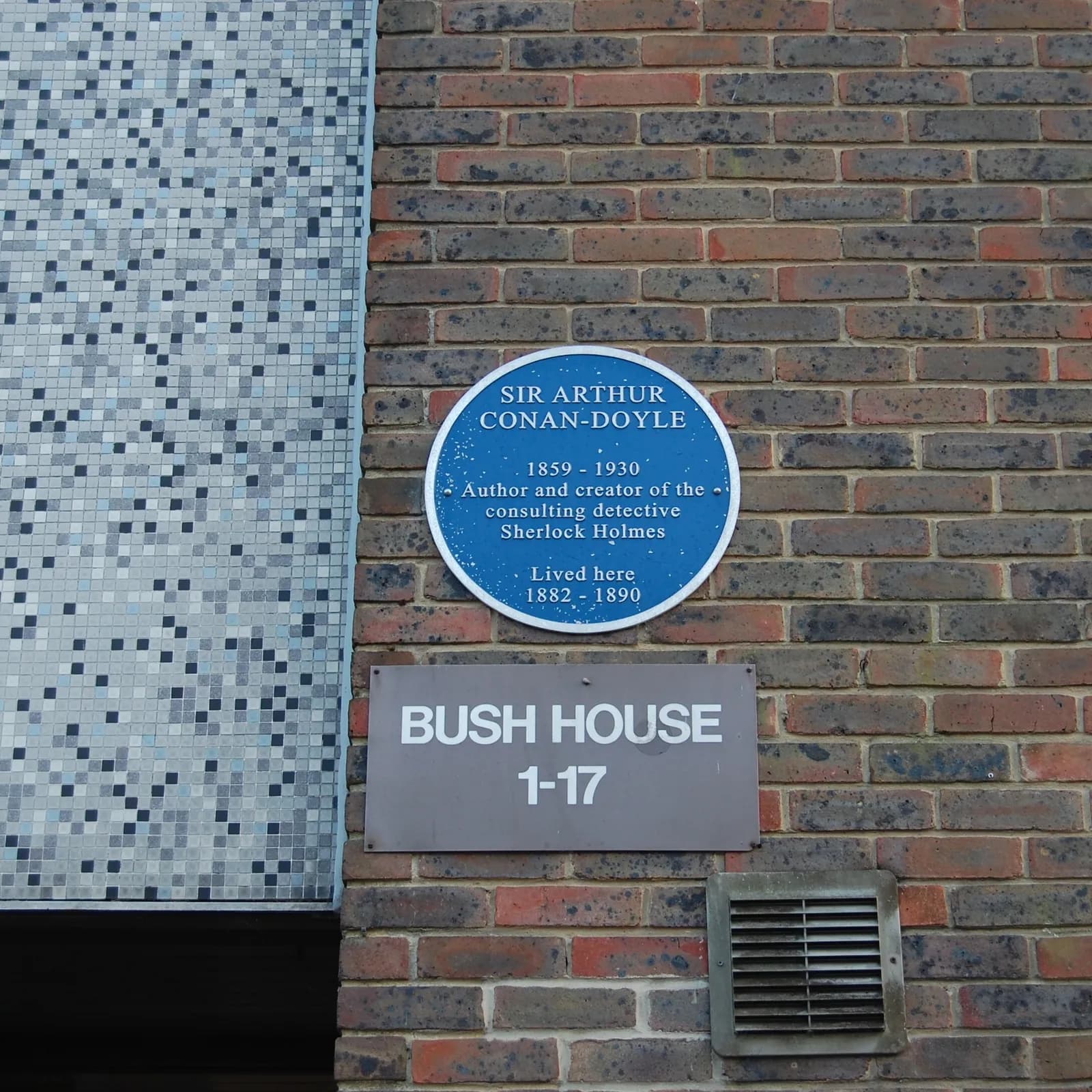
Today, Portsmouth recognises its connection to Sherlock Holmes's creator through official commemoration. Portsmouth City Council has erected a plaque honouring Arthur Conan Doyle, placing it among those commemorating notable figures associated with the city. While not part of the English Heritage blue plaque scheme, this municipal marker acknowledges Doyle's contribution to world literature and his significant association with Portsmouth.
The plaque is located at Bush House on Elm Grove, Southsea; marking the very building where Doyle lived and worked during those formative years. Visitors to the site can see this tangible link to literary history, standing on the same street where a struggling young doctor transformed himself into one of the most successful authors of his age.
Doyle left Southsea in 1891, moving first to Vienna to study ophthalmology before settling in London. He departed having established the character and world that would define his reputation and influence popular culture for more than a century to come.